Radar False Alarms: How They Affect Your Product and How to Reduce Them
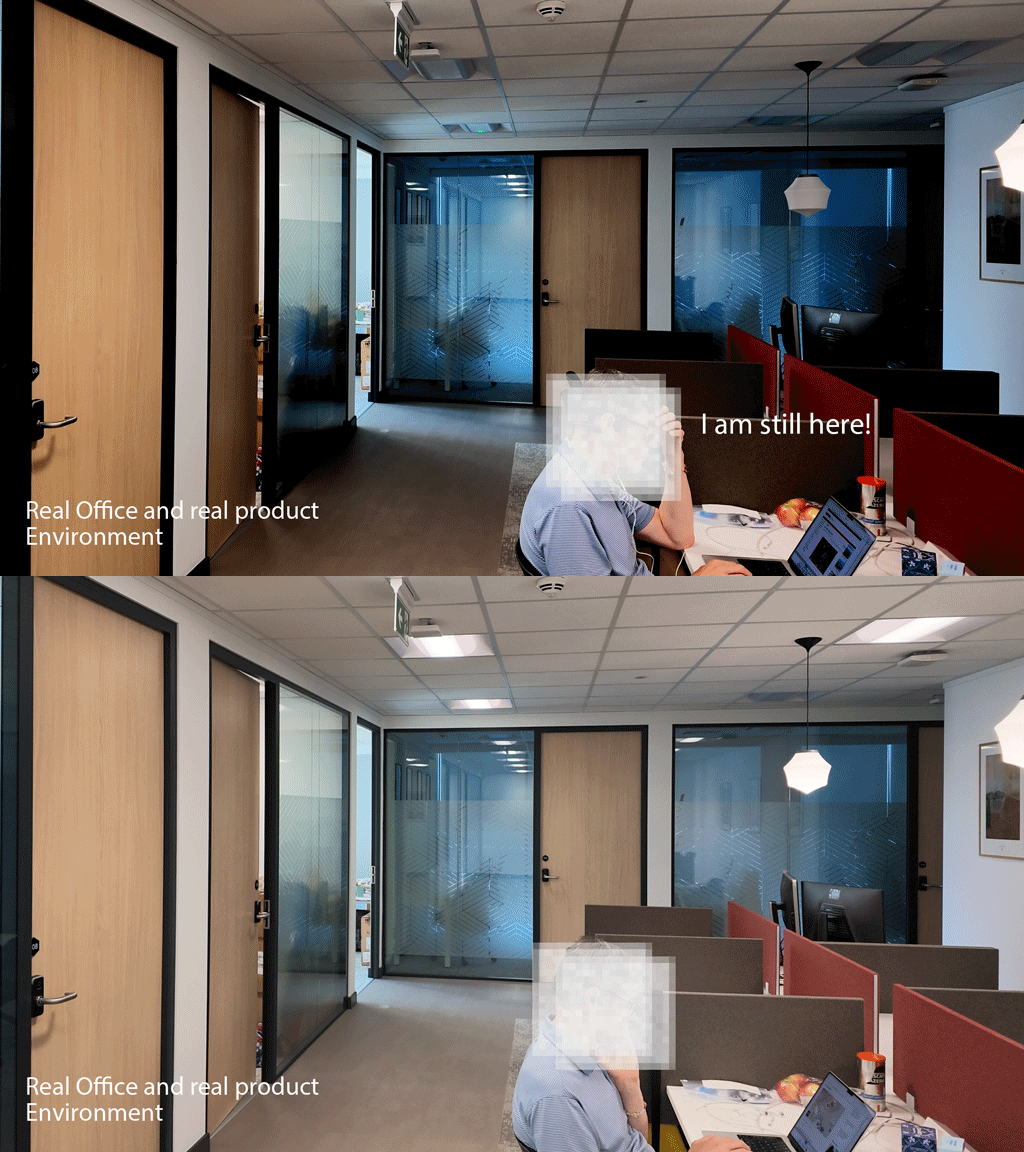
Meta Description: Learn how radar false alarms and false vacancy affect product reliability, customer experience and energy control, and how better motion and stationary human detection can reduce unwanted switching.
Radar False Alarms: How They Affect Your Product and How to Reduce Them
A light switching on because a curtain moved is one type of sensing failure.
But there is another problem that can be even more frustrating:
the light switching off while someone is still in the room.
This often happens when a system detects motion rather than true human presence.
A person may be sitting quietly in an office, reading in a meeting room, or remaining relatively still in a toilet cubicle. If the sensing system no longer detects enough movement, it may incorrectly decide that the space is vacant.
The result is a false vacancy.
For customers, both problems feel like product failure:
False detection → equipment switches on when nobody is there
False vacancy → equipment switches off while somebody is still there
This is why reliable sensing is not simply about avoiding false triggers. It is about correctly understanding whether a person is actually present.
Why False Vacancy Can Be a Serious User-Experience Problem
Traditional motion-based systems often use a timer.
The logic is simple:
Movement detected → ON
No movement for a period → OFF
This works well when people are continuously moving.
But real human behaviour is different.
People may remain almost stationary while:
working at a computer
reading
attending a meeting
watching a presentation
resting
using a toilet
waiting in a room
If the system relies only on larger motion events, it may interpret stillness as absence.
In an office, the lights may suddenly switch off while somebody is working.
In a meeting room, lighting or HVAC may change state during a presentation.
In a toilet, the lighting may switch off while the space is still occupied.
These are not small technical details. They directly affect comfort, safety perception, privacy, customer trust and product reputation.
False Alarm vs False Vacancy
A reliable occupancy system must control both sides of the problem.
False Occupancy
The space is empty, but the system reports somebody present.
This can cause:
unnecessary lighting
unnecessary HVAC operation
wasted energy
incorrect occupancy data
unnecessary equipment activation
False Vacancy
A person is still present, but the system reports that the space is empty.
This can cause:
lights switching off unexpectedly
HVAC or ventilation changing state
automated equipment entering standby
poor customer experience
users losing trust in the automation
Reducing one problem by simply changing sensitivity can make the other problem worse.
If sensitivity is increased too much, the system may detect curtains, fans or movement outside the target area.
If sensitivity is reduced too much, it may fail to detect a person who is sitting still.
The goal is therefore not maximum sensitivity.
The goal is reliable human detection with controlled rejection of unwanted movement.
Stationary Human Detection Changes the System
This is where stationary human detection becomes important.
A conventional motion detector mainly asks:
“Did something move?”
A human presence sensor asks a more useful question:
“Is somebody still here?”
At 24GHz, a human presence sensing system can detect subtle human micro-movements such as small body movement, posture changes and other low-level motion that may remain even when the person appears stationary.
This allows an occupancy system to continue recognising a person after obvious walking movement has stopped.
For applications such as:
offices
meeting rooms
toilets
classrooms
hotel rooms
smart homes
HVAC control
lighting control
this can significantly improve the user experience.
Why Long PIR Timeouts Are Not Always the Best Answer
A common way to prevent lights switching off too quickly is simply to increase the timeout.
For example, instead of switching off after 2 minutes without movement, the system may wait 10, 20 or even 30 minutes.
This reduces false switch-offs.
But it creates another problem.
If the person actually leaves, the lighting or HVAC may continue operating for the entire timeout period.
This wastes energy.
A better sensing system attempts to determine whether the space is actually occupied, rather than estimating occupancy from the last detected motion event.
That can allow shorter and more confident vacancy delays without sacrificing user comfort.
What Causes Radar False Alarms?
Radar false alarms can come from many sources, including:
moving curtains or blinds
ceiling fans
opening doors
machinery or vibration
movement outside the intended sensing area
activity behind lightweight partitions
incorrect mounting
excessive sensing range
The radar may technically be detecting real movement.
The problem is that the movement is not relevant to the application.
Good radar sensing is therefore not about detecting everything.
It is about identifying the right human activity while ignoring movement that should not affect the product.
Use Spatial Information to Improve Decisions
More advanced radar sensing can provide information such as:
distance
angle
target location
sensing zone
This allows the system to make more selective decisions.
For example, a meeting-room sensor may need to recognise a seated person at the table while ignoring someone walking past the doorway.
Instead of simply increasing or decreasing overall sensitivity, spatial information helps the system understand where the activity is happening.
KW307: Designed for Human Presence, Not Just Motion
Keywave’s KW307 is a 24GHz human presence sensing SoC designed for embedded and OEM applications.
It is designed to detect both moving and stationary occupants through subtle human micro-movement sensing.
It can also provide spatial information such as target distance and angle, helping the wider system understand where human activity is occurring.
This is particularly useful for applications where false vacancy matters, including:
smart offices
meeting rooms
toilets and washrooms
HVAC control
smart lighting
building energy management
intelligent appliances
Edge AI devices
The key advantage is not simply more sensitivity.
It is the ability to maintain awareness of human presence even when obvious movement has stopped.
For many smart-building applications, that difference can prevent the system from incorrectly switching off while the space is still occupied.
https://keywavetech.co.uk/products
KW007: Motion Detection for Simpler Applications
Not every product needs stationary human detection.
For applications that mainly require approach or movement detection, Keywave’s KW007 5.8GHz radar motion sensing IC and module family provides a simpler solution.
Typical applications include:
smart lighting
appliances
embedded equipment
approach detection
automatic activation
In these applications, configuring the correct detection range is important.
If the product only needs to detect movement within 2 metres, limiting the sensing zone can help reduce unnecessary triggers from activity farther away.
Test Both “Should Detect” and “Should Ignore”
A reliable product should not only be tested with people walking in front of the sensor.
It should also be tested against real situations such as:
a person sitting still
someone working quietly at a desk
a user inside a toilet cubicle
fans running
curtains moving
doors opening
people walking outside the intended area
nearby machinery
long periods of occupancy without large movement
This is critical because a system can perform well in a simple motion demonstration but still fail in real occupancy conditions.
The Customer Only Sees the Final Behaviour
Customers do not see RF reflections, thresholds, antenna patterns or signal-processing algorithms.
They see:
the light switched on when nobody was there
or
the light switched off while I was still inside.
Both affect trust.
For OEMs, sensing performance therefore influences:
customer satisfaction
support costs
product reviews
energy-saving performance
repeat purchases
brand reputation
For motion-based products, KW007 provides configurable 5.8GHz radar motion sensing.
For applications where stationary human presence must be maintained, KW307 provides 24GHz human presence sensing with micro-movement and spatial information.
The goal is simple:
Detect when people arrive.
Know when they remain.
Recognise when they actually leave.
KEYWAVE
KEYWAVE Technology Limited
Office : Mocatta House, Trafalgar Place, Brighton, BN1 4DU
Lab : Sussex Innovation Centre, Science Park Square, BN1 9SB, UK
Email: W@keywavetech.co.uk
Copyright © 1995-2026, Keywave. All Rights Reserved.